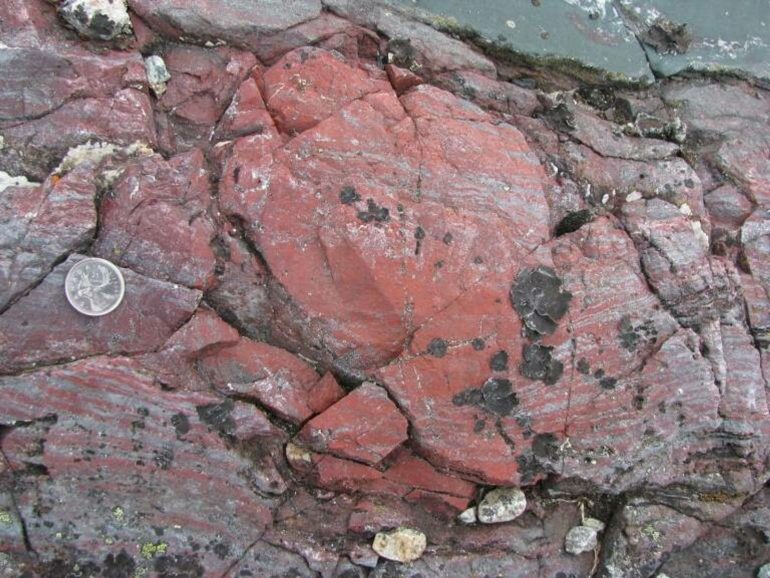
complex track in rock
The Nuvvuagittuq Greenstone Belt from which specimens originated formed part of the ocean floor billions of years ago and contains some of the oldest known sedimentary rocks. To examine the rock, the researchers cut it into separate pieces, analyzing which they eventually found complex tracks: a tree-like structure with a trunk and parallel branches on one side and hundreds of other circular tracks. About a centimeter in length, the structure is significantly larger and more complex than previously thought.
To ensure that the structures are not abiotic – that is, lifeless – structures but are of biological origin, the researchers compared compositions found with young fossils and those of iron-oxidizing bacteria. In doing so, they found the equivalent of twisted branching formations and deformed areas found in the Nuvvugittuk rock. So the assumption is clear that the marks in the rock may actually have come from the first known living beings on Earth. “Our study strongly suggests that different types of bacteria existed on Earth between 3.75 and 4.28 billion years ago,” said Papinou, Professor of Geochemistry and Astrobiology at University College London and lead author of the study. However, the final result requires further results.

Claire Montgomery is a contributor to CA News Ottawa, covering news, politics, business, technology, sport, entertainment, and lifestyle. She focuses on clear, accurate reporting and useful information that helps readers stay informed about current affairs and developments that shape their communities. Her work highlights relevant stories, emerging trends, and important issues, presenting them in a balanced, accessible, and reader-friendly manner.