
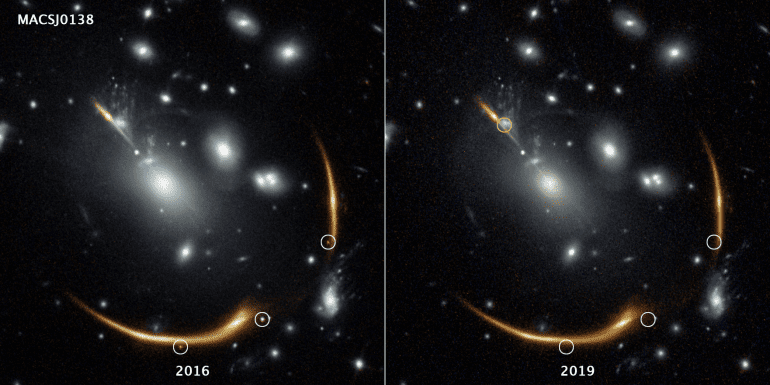

This stellar explosion occurs in a galaxy that has four images in the sky. The Milky Way is ten billion light-years away, just behind a massive cluster of galaxies that are less than half as far away.
Its gravity bends the rays of light from the galaxy into the background. Like a cosmic kaleidoscope, it provides four images of the same object – these images are also elongated and amplified.
Experts speak of the gravitational lens effect, which goes back to the general theory of relativity. At first glance, galaxy clusters and distorted images are reminiscent of a smiley face.
Three of the four images of the Milky Way showed a supernova a few years ago. So far in the fourth image, this has not happened – there astronomers expect a stellar explosion to flare up in 2037.
The twisted rays of light in the four images travel across the universe along different lengths. The first three burned out within about half a year.
In the fourth picture, the path of light is so long that it lags behind by about twenty years. In the late 1930s, experts waited to see how the supernova glowed in the final picture.

Emma Fairchild is a contributor to CA News Ottawa, covering news, politics, business, technology, sport, entertainment, and lifestyle. She focuses on clear, accurate reporting and useful information that helps readers stay informed about current affairs and developments that shape their communities. Her work highlights relevant stories, emerging trends, and important issues, presenting them in a balanced, accessible, and reader-friendly manner.